What if the “breadbasket of the world” is simply speaking a language your immune system hasn’t learned to translate yet?
The Modern Grain Mystery
For decades, gluten was just the “glue” that gave our sourdough its chew and our pastries their flake. But recently, our relationship with this ancient protein has shifted from a staple to a scientific puzzle. If you’ve felt that post-pasta fog or unexplained bloat, you aren’t imagining things—and you certainly aren’t alone.
Latest clinical data suggests that nearly 6% to 7% of the population may have some form of non-celiac gluten sensitivity, while Celiac disease diagnoses have risen significantly over the last 50 years. This isn’t a “fad” trend; it’s a biological intersection of genetics, microbiome health, and modern food processing. Today, we’re peeling back the microscopic layers of the wheat kernel to understand exactly what happens when grain meets gut.
The Biological “Why”: Understanding the Reaction
To understand why your body reacts to grain, we have to look at the chemistry. Gluten isn’t a single molecule; it’s a complex composite of two proteins: gliadin and glutenin.
The human body lacks the specific enzymes required to fully break down these proteins into their smallest amino acid components. In most people, these undigested fragments pass through the digestive tract harmlessly. However, for others, the body views these fragments as foreign invaders, triggering a range of physiological defenses.
Intolerance vs. Allergy: Knowing the Difference
It is a common misconception that all gluten reactions are the same. In reality, your body has very different ways of saying “no thanks” to wheat.
| Feature | Gluten Intolerance (Sensitivity) | Wheat Allergy |
| System Involved | Digestive / Innate Immune System | IgE-Mediated Immune System |
| Mechanism | Difficulty digesting the protein; creates localized inflammation. | The body treats wheat as a literal toxin (like a bee sting). |
| Onset | Delayed (hours or days after eating). | Immediate (minutes to an hour). |
| Symptoms | Bloating, “brain fog,” joint pain, fatigue. | Hives, swelling, wheezing, or anaphylaxis. |
| Long-term Risk | Chronic discomfort and low-grade inflammation. | Potential for life-threatening respiratory distress. |
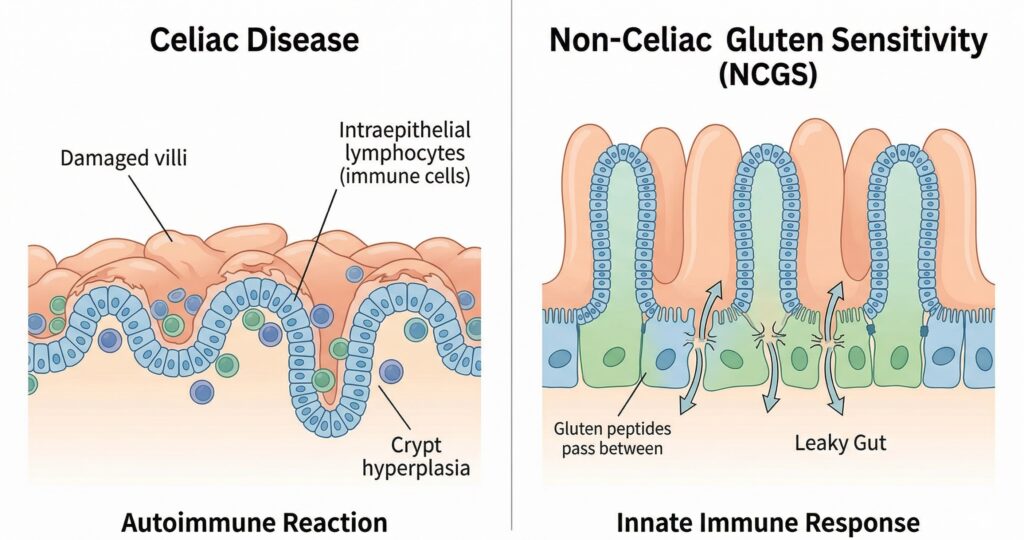
The Microscopic Battleground: The Zonulin Key
The most significant breakthrough in understanding gluten reactivity involves a protein called Zonulin.
When certain individuals consume gluten—specifically the gliadin component—it triggers the release of Zonulin in the small intestine. Think of Zonulin as the “gatekeeper” of your gut lining. In a healthy state, your intestinal cells are knit tightly together by “tight junctions” to prevent undigested food and toxins from entering your bloodstream.
The Domino Effect
- Opening the Gates: Increased levels of Zonulin cause these tight junctions to pry open. This phenomenon is scientifically known as increased intestinal permeability, or “Leaky Gut.”
- The Immune Alarm: Once the gut lining is breached, undigested gluten fragments slip through into the underlying tissue.
- The Inflammatory Cascade: Your immune system sees these “intruders” and launches an attack. This is why gluten sensitivity doesn’t just stay in the stomach; it manifests as systemic issues like neuro-inflammation (brain fog) and systemic fatigue.
The “Perfect Storm”: Why Now?
Why does this happen to one person and not another? It’s usually a combination of a “Double-Lock” scenario:
- Genetic Predisposition: Most people with significant gluten issues carry specific variants of the HLA-DQ2 or HLA-DQ8 genes. These act like “sensors” hyper-tuned to detect gluten fragments.
- Debranched Breeding: Modern wheat has been bred for higher yields and “stretchier” dough, resulting in a higher concentration of the specific $D$-genome gluten proteins that are most reactive.
- The Microbiome Shift: Our gut flora plays a massive role in pre-digesting gluten. When beneficial bacteria are missing due to diet or environment, the full force of the gluten protein hits the gut lining.
- Fermentation Loss: Traditional long-fermentation processes (like authentic sourdough) allow wild yeast to break down inflammatory proteins before they reach your plate. In the modern fast-bread era, our stomachs do all the heavy lifting.
The Power of Knowledge: Decoding the Label
Navigating the “Gluten Synthesis” requires more than just avoiding wheat; it requires a deep understanding of food ingredients and their functions. In our modern food system, gluten and its derivatives often hide behind technical names or are used as functional additives for texture, stability, or shelf-life. When we stop viewing an ingredient list as “jargon” and start seeing it as a roadmap for our health, we reclaim power over our biology. Understanding why an ingredient is there—whether it’s a stabilizer, a hidden thickener, or a vital nutrient—is the first step in moving from reactive eating to proactive wellness.

Take Control with the Honest About Ingredients™ App
Tired of playing detective in the grocery aisle? Stop guessing and start knowing. The Honest About app is your revolutionary tool for total food transparency.
- Scan & Know: Simply point your camera at any ingredient label to instantly identify what’s inside.
- Plain Language: Get straightforward, no-jargon explanations of what every ingredient actually does in your food.
- Go Deep: Access scientific details and FDA standards to make the most informed choices for your body.
Ready to eat with confidence? Download the Honest About Ingredients™ app on the App Store or Google Play today and finally understand what’s on your plate.