Beyond its role as a culinary staple, Extra Virgin Olive Oil (EVOO) serves as a potent molecular modulator that talks directly to your cells.
The Mediterranean diet has long been the subject of intensive epidemiological study, with olive oil identified as one of its primary bioactive components. While public health guidance often simplifies its benefits as “heart-healthy,” a deeper examination of its molecular structure reveals a sophisticated delivery system of health-promoting compounds. EVOO isn’t just a source of calories; it is a complex “pharmacy in a bottle,” containing over 30 distinct phenolic compounds that interact with human physiology at a cellular level. Recent clinical research indicates that its unique chemical profile actively regulates metabolic pathways and alters the expression of genes associated with inflammation and cellular repair. By analyzing these biochemical mechanisms, we can transition from anecdotal evidence to understanding how this ancient extract serves as a cornerstone of modern preventative medicine.

The Anatomy of Olive Oil: Bioactive Constituents
To understand the efficacy of olive oil, we must dissect its chemical composition into two primary categories: the fatty acid profile and the minor polar fraction.
- Oleic Acid (18:1): A mono-unsaturated fatty acid (MUFA) that constitutes 55% to 83% of the oil’s total volume. It is remarkably stable and highly resistant to lipid peroxidation compared to poly-unsaturated fats.
- The Phenolic Fraction: Includes key secoiridoids such as Oleuropein and Oleocanthal, as well as the potent antioxidant Hydroxytyrosol.
- The Lipid Matrix: Comprising Vitamin E (Alpha-tocopherol) and Squalene, which act as secondary antioxidants and precursors to essential hormonal structures.
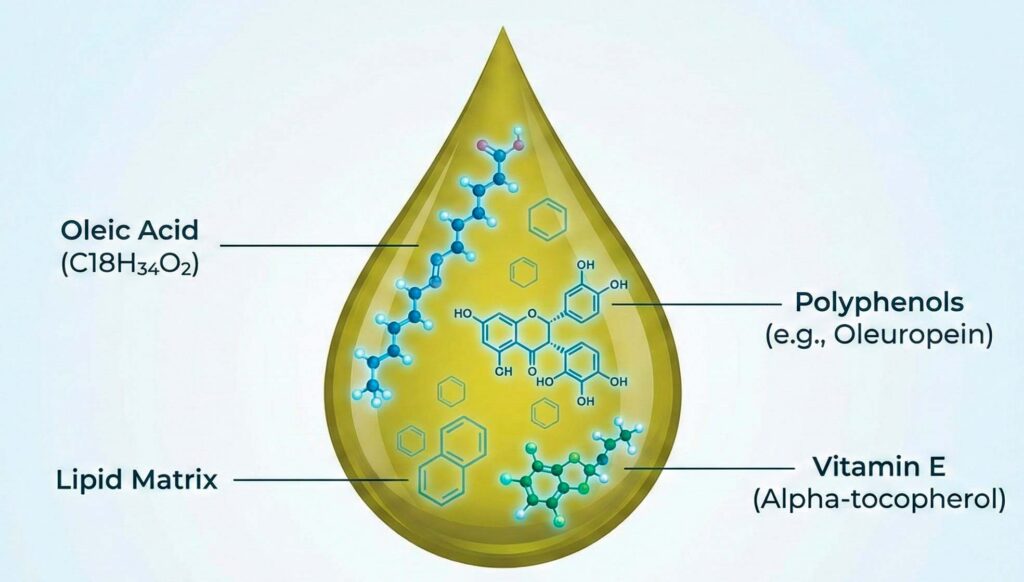
Biological Pathways: How Ingredients Power Your Health
The health benefits of olive oil are derived from specific biochemical interactions within the human body:
1. Building “Bulletproof” Cells (Oleic Acid)
Every cell in the human body is encased in a lipid membrane. By incorporating oleic acid into these membranes, the body increases the structural stability of the cell. This substitution reduces the susceptibility of the cell wall to oxidative damage, thereby improving cellular communication and insulin receptor sensitivity.
2. A Natural Anti-Inflammatory (Oleocanthal)
The “peppery” sensation characteristic of high-quality EVOO is caused by Oleocanthal. This compound acts as a natural inhibitor of cyclooxygenase (COX) enzymes. By modulating the same pathways as common anti-inflammatory drugs, it helps mitigate the low-grade systemic inflammation that underpins chronic metabolic disease.
3. Cardiovascular Armor (Hydroxytyrosol)
Hydroxytyrosol is one of the few antioxidants capable of crossing the blood-brain barrier. Its primary clinical function is the protection of Low-Density Lipoprotein (LDL) from oxidative stress. Since oxidized LDL is a primary driver of atherosclerosis (the hardening of arteries), this mechanism is a critical factor in cardiovascular disease prevention.
The “Force Multiplier” Effect: How It All Works Together
In nutritional science, synergy is paramount; olive oil represents a masterclass in biological cooperation. The MUFA base (oleic acid) serves as a stable hydrophobic vehicle, essential for the bioavailability of the oil’s fat-soluble polyphenols and vitamins. Without the lipid carrier, many of these micronutrients would be poorly absorbed by the gastrointestinal tract.
Furthermore, while the fatty acids work to fortify the cellular architecture, the polyphenols actively quench the reactive oxygen species (ROS) that threaten that architecture. This “outside-in” defense system creates a level of efficacy that synthetic or isolated supplements cannot replicate.
Olive Oil in the Modern Nutritional Landscape
In a diet frequently dominated by some ultra-processed seed oils—which are often rich in pro-inflammatory Omega-6 fatty acids—extra virgin olive oil serves as a necessary corrective. Despite common misconceptions, high-quality EVOO possesses high oxidative stability, with a smoke point ranging from 190°C to 210°C (375°F to 410°F). More importantly, its use as a “flavor carrier” for nutrient-dense vegetables increases the absorption of fat-soluble vitamins (A, D, E, and K) from other foods, making it a “force multiplier” for a whole-food diet.
A Foundation for Resilience
Olive oil is far more than a kitchen convenience; it is a foundational pillar of health validated by both tradition and clinical scrutiny. By providing the body with stable structural lipids and a specialized suite of anti-inflammatory compounds, it protects the cardiovascular, neurological, and metabolic systems from the cumulative damage of daily life. Choosing a high-quality, cold-pressed extra virgin oil is a strategic investment in biological resilience.
The Imperative of Food Literacy
The study of olive oil underscores a vital shift in how we must approach nutrition: we must look beyond “macro-nutrients” and “calories.” When we understand the specific function of food ingredients—how a polyphenol interacts with an enzyme or how a fatty acid stabilizes a cell membrane—we regain our biochemical agency. Food is not merely fuel; it is a series of chemical instructions for the body. Cultivating an understanding of these functions allows us to transition from a reactive approach to health to a proactive one, where the kitchen becomes the primary site of preventative medicine.
Knowledge is Power
Don’t just count calories—make your ingredients count. Use the Honest About App to get the full breakdown of what’s actually in your pantry, from healthy lipids to hidden additives.